La-JEPA
Compact Robot Policies with Latent World Modeling
Compact robot policies trained in a pretrained JEPA feature space, learning actions and future features jointly while predicting only actions at deployment.
Motivation
Many robot policies inherit large transformers built for generating video or language. La-JEPA asks whether a policy can instead be designed around control, while still benefiting from pretrained visual representations. The goal is to separate the knowledge learned from video from the size and architecture of the policy that produces actions.
Approach
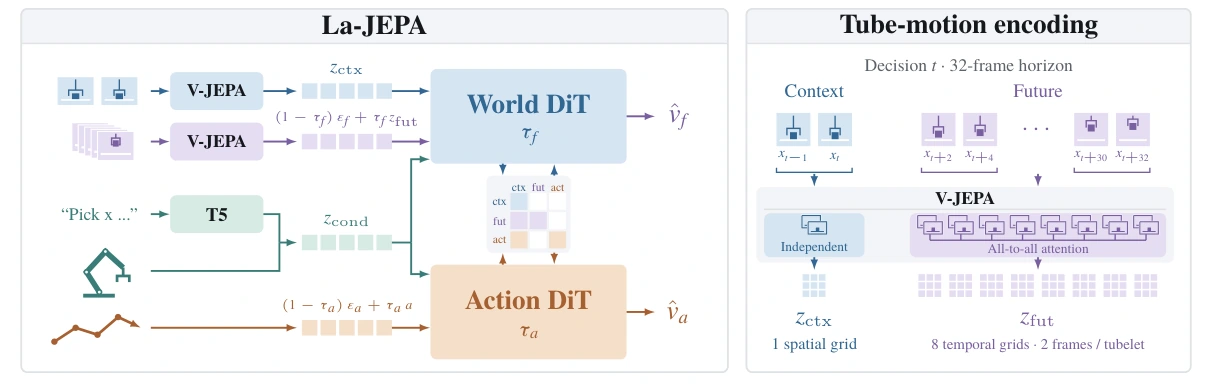
A policy transformer trained from scratch uses a pretrained V-JEPA 2.1 encoder. Joint feature and action prediction allows the policy architecture to be designed for control.
The model predicts features rather than reconstructing pixels. Its tube-motion encoding uses a two-frame observation to capture recent motion and jointly encodes future targets over a 32-frame horizon. During training, actions can attend to observations but not future features. At deployment, future prediction is removed, observation keys and values are cached once, and only the action transformer runs through the repeated denoising steps.
Reported results
La-JEPA L reaches 82.3% on LIBERO-Plus. Under the clean-trained RoboTwin 2.0 protocol, La-JEPA B reports 61.8% mean success across clean and randomized evaluations, in comparisons without embodied pretraining.
Scope
Physical evaluations cover four tasks on one setup. The results do not establish broad real-world parity with larger pretrained policies.